📊 BSBY Explained: 5 Key Facts About Bloomberg’s Short-Term Bank Yield Index
In today’s post-LIBOR financial landscape, BSBY—Bloomberg’s Short-Term Bank Yield Index—has emerged as a critical benchmark for short-term borrowing and lending. Launched in 2021, it was designed to reflect the actual funding costs banks incur in unsecured wholesale markets—offering a credit-sensitive alternative to the nearly risk-free SOFR. For corporate treasurers, mortgage lenders, and investors, understanding BSBY is no longer optional: it underpins $1.2+ trillion in loans, floating-rate notes, and adjustable-rate mortgages (ARMs). Let’s break down what Bloomberg’s Short-Term Bank Yield Index is, how it’s calculated, and why it matters for your financial decisions.
🔍 What Is BSBY: Bloomberg’s Short-Term Bank Yield Index?
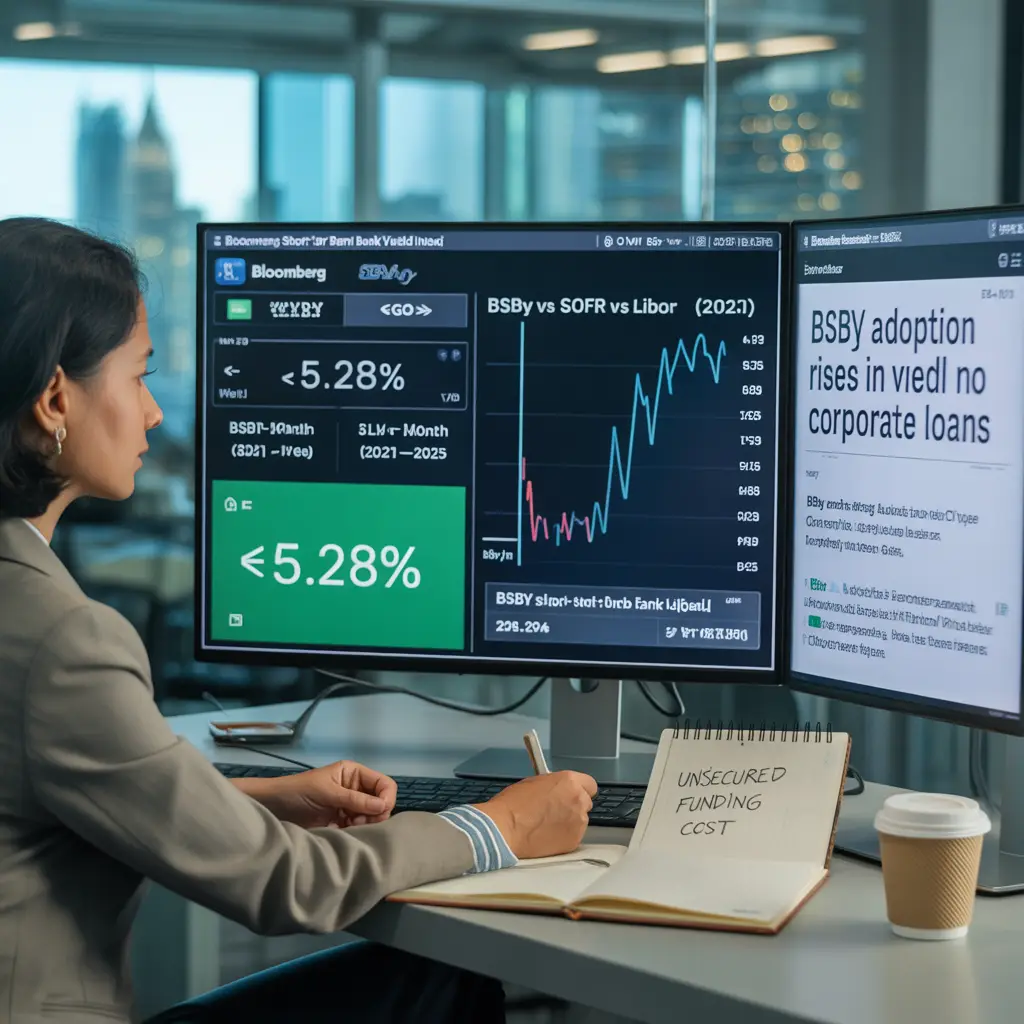
Bloomberg’s Short-Term Bank Yield Index is a daily benchmark rate based on transactional data from U.S. banks’ unsecured wholesale funding markets, including negotiable certificates of deposit (NCDs), commercial paper (CP), and short-term unsecured deposits. Unlike SOFR (which reflects securedTreasury repo transactions), it is incorporates bank credit risk—making it a closer analog to the defunct LIBOR.
Key Features of BSBY:
- Tenors: 1-month, 3-month, 6-month, and 12-month
- Publication: ~8:00 AM ET daily (Bloomberg Terminal:
{BSBY <GO>}) - Administrator: Bloomberg Index Services Limited (BISL)
- Regulatory status: Approved by the ARRC (Alternative Reference Rates Committee) as a LIBOR fallbackfor certain legacy contracts.
📌 Note: it is transaction-based—only including actual trades (not quotes), ensuring robustness and tamper resistance.
⚖️ How It Differs from SOFR and LIBOR
| Feature | BSBY | SOFR | LIBOR |
|---|---|---|---|
| Underlying Market | Unsecured bank funding (CP, NCDs) | Secured Treasury repo | Unsecured interbank (quotes) |
| Credit Risk | ✅ Yes (bank-specific) | ❌ No (risk-free) | ✅ Yes (but unverifiable) |
| Data Source | Real transactions | Real transactions | Panel bank submissions |
| Term Structure | Forward-looking (term rates) | Overnight (term SOFR interpolated) | Forward-looking |
💡 Why this matters:
- Lenders prefer Bloomberg’s Short-Term Bank Yield Index for floating-rate loans—it better reflects their actual cost of funds.
- Borrowers in strong credit tiers may negotiate SOFR + spread for lower rates.
- ARMs increasingly use 3-month BSBY for better alignment with bank funding (e.g., Fannie Mae’s BSBY-indexed ARMs).
🌐 Official ARRC guidance on fallbacks: ARRC Paced Transition Plan
📈 How BSBY Is Calculated
It uses a volume-weighted median methodology to ensure resilience:
- Eligible Instruments:
- U.S. dollar-denominated commercial paper (CP)
- Negotiable certificates of deposit (NCDs)
- Short-term unsecured deposits (≤1 year)
- Data Collection: Bloomberg aggregates anonymized, executable trade data from broker-dealers, banks, and electronic platforms.
- Calculation:
- For each tenor (e.g., 3-month), trades are sorted by rate.
- A volume-weighted median is computed (not simple average).
- Minimum volume thresholds apply (e.g., $500M daily for 3-month BSBY).
- Publication:
Final rates published at 8:00 AM ET via Bloomberg Terminal, Bloomberg Indices, and data vendors.
🔍 Transparency: Full methodology: Bloomberg BSBY Methodology
💼 Real-World Impact: Where Is it Used Today
Since its 2021 launch, Bloomberg’s Short-Term Bank Yield Index adoption has accelerated across sectors:
- Corporate Loans: Over 35% of new U.S. syndicated loans now use it (LSTA, Q1 2025)
- Floating-Rate Notes (FRNs): Issuers like Apple and Microsoft have issued BSBY-linked debt
- Mortgages: Fannie Mae offers BSBY-indexed ARMs; lenders like Quicken Loans use it for jumbos
- Derivatives: CME Group lists BSBY futures and OTC swaps
📊 Example: A $5M commercial loan at “3-month BSBY + 2.5%” adjusts quarterly based on actual bank funding costs—not theoretical repo rates.
⚠️ Limitations and Criticisms
Despite its strengths, BSBY faces scrutiny:
- Lower liquidity: Unsecured CP/NCD markets are smaller than Treasury repo → potential volatility in stress periods.
- Bank concentration: Top 5 banks account for ~60% of underlying volume (per Fed analysis).
- SOFR dominance: SOFR remains the primary ARRC-recommended rate; it is a “supplemental” alternative.
Still, the Fed acknowledges it’s role in a multi-rate ecosystem—especially for credit-sensitive applications. See: Federal Reserve BSBY Commentary
🔮 The Future of Bloomberg’s Short-Term Bank Yield Index
As legacy LIBOR contracts fully sunset (June 30, 2024 for most USD LIBOR), it is poised for growth—especially in:
- Private credit (direct lending funds)
- Middle-market lending (banks seeking credit-aligned benchmarks)
- International markets (e.g., EMEA corporates issuing USD debt)
Bloomberg continues enhancing transparency, including daily volume disclosures and expanded tenors.
✅ Key Takeaways
- Bloomberg’s Short-Term Bank Yield Index reflects real unsecured bank funding costs.
- It’s a credit-sensitive SOFR alternative, ideal for loans, ARMs, and FRNs.
- Unlike LIBOR, it’s transaction-based and auditable.
- Watch for rising adoption in corporate finance and mortgage markets.
Understanding Bloomberg’s Short-Term Bank Yield Index isn’t just for quants—it’s essential for anyone navigating today’s benchmark transition.