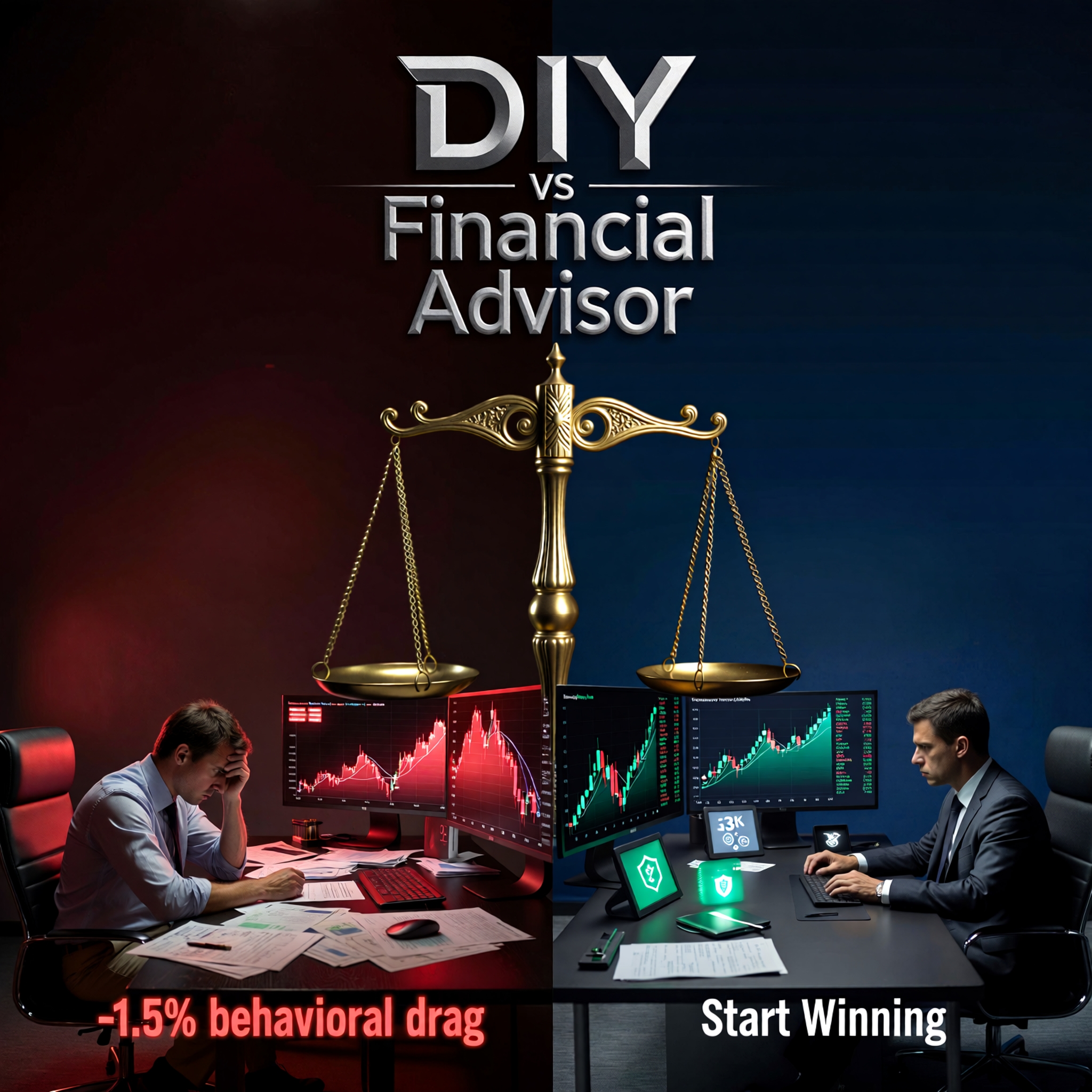
DIY vs financial advisor cost calculator
💡 How It Works
Users input:
- Portfolio size
- Expected return
- Time horizon
- DIY behavioral penalty (e.g., panic-selling)
- Advisor fee (% AUM)
The calculator outputs:
- Projected portfolio value for both paths
- Net difference after 10/20/30 years
- Personalized recommendation
DIY vs Financial Advisor Cost Calculator
See which path builds more wealth after fees, taxes, and behavioral mistakes. Based on Vanguard’s research.
Your Portfolio
DIY Assumptions
Advisor Assumptions
20-Year Wealth Comparison
| DIY Investing | Fiduciary Advisor | |
|---|---|---|
| Net Annual Return | 5.40% | 7.00% |
| Projected Value | $714,000 | $967,000 |
| Net Difference | Advisor builds $253,000 more | |
DIY vs Financial Advisor Cost Calculator: Which Path Builds More Wealth in 2026?
DIY vs financial advisor cost calculator, You’ve got two choices:
- Manage your own investments—save on fees, keep full control.
- Hire a financial advisor—pay for expertise, gain peace of mind.
But which one actually builds more wealth over 10, 20, or 30 years?
The answer isn’t as simple as “fees = bad.” In fact, the cheapest option is often the most expensive—thanks to hidden costs like panic-selling, poor tax planning, and emotional decision-making.
That’s why we built the DIY vs Financial Advisor Cost Calculator: a free tool that compares both paths after accounting for real-world behavior, not just theory.
👉 Try it now → [Free Calculator]
🔍 The Myth: “Advisors Are Too Expensive”
Most people assume:
“If I pay a 1% advisor fee, I’ll lose 1% in returns every year. DIY is clearly better.”
But this ignores three critical factors:
✅ 1. Behavioral Drag (The DIY Tax)
Vanguard research shows the average DIY investor underperforms their portfolio by 1.5% per year due to:
- Panic-selling in crashes (e.g., 2022’s -25% drop)
- Chasing performance (buying high, selling low)
- Inconsistent contributions
This “behavioral drag” is the #1 wealth killer—and it’s invisible on paper.
✅ 2. Advisor Alpha (The Value Add)
A good fiduciary advisor doesn’t just manage money—they add 3%+ in annual value through:
- Tax-loss harvesting (saving 0.5–1.0%)
- Optimal asset allocation (0.3–0.5%)
- Behavioral coaching (1.0–1.5%)
- Withdrawal sequencing in retirement (0.7%)
📊 Source: Vanguard’s “Advisor’s Alpha” study (2023 update)
✅ 3. Fee Transparency
- DIY “fees”: ETF expense ratios (0.03–0.20%) + hidden trading costs
- Advisor fees: Typically 0.8–1.2% AUM—but all-inclusive (planning, tax, behavioral support)
💡 Key insight: Paying 1% for 3% in value increases your net returns.
📈 Real Example: $250K Portfolio Over 20 Years
Let’s compare two paths—using realistic 2026 assumptions:
| Assumption | DIY | Advisor |
|---|---|---|
| Starting Portfolio | $250,000 | $250,000 |
| Gross Return | 7.0% | 7.0% |
| Behavioral Drag | -1.5% | 0% (coaching) |
| Portfolio Fees | -0.10% | -1.0% (fee) |
| Advisor Alpha | 0% | +1.5% (tax + allocation) |
| Net Annual Return | 5.4% | 7.0% |
| Value in 20 Years | $714,000 | $967,000 |
Result: The advisor client ends up with $253,000 more—despite paying $1,000+/year in fees.
🎯 The lesson: It’s not about fees. It’s about net outcomes.
🤔 Who Should Go DIY? (And Who Needs an Advisor?)
✅ DIY Is Right For You If:
- You’re emotionally disciplined (held or bought in 2022)
- You understand tax-efficient fund placement (Roth vs. taxable)
- Your finances are simple (W-2 income, no stock options, no rental properties)
- You enjoy managing money (or use robust tools like Yieldoom)
🛠️ DIY Toolkit: Use our CD Ladder Builder, Real Yield Calculator, and Max Drawdown Tolerance Toolto stay on track.
✅ Hire an Advisor If:
- You have complex income (RSUs, 1099, K-1s)
- You’re within 5 years of retirement
- You’ve sold low in past crashes
- You value time and peace of mind over absolute control
🔍 Pro Tip: Only hire fee-only fiduciaries (CFP® + RIA). Avoid commission-based “advisors.”
💰 How Our Calculator Works
Our DIY vs Financial Advisor Cost Calculator models both paths using Vanguard-backed assumptions:
- You input:
- Portfolio size
- Time horizon
- Expected return
- You adjust:
- DIY behavioral penalty (0–5%)
- Advisor fee (0.3–2.0%)
- Advisor alpha (0–3.0%)
- You get:
- Projected portfolio value for both paths
- Net difference after 10/20/30 years
- Personalized recommendation
No jargon. No bias. Just clarity.
👉 See your numbers in 60 seconds → [Free Calculator]
🚫 Common Misconceptions
❌ “Robo-advisors are the middle ground.”
→ Most robos (e.g., Betterment, Wealthfront) don’t offer behavioral coaching—the #1 source of advisor value. They’re just automated DIY.
❌ “I can learn everything online.”
→ Knowledge ≠ execution. Knowing you shouldn’t panic-sell doesn’t stop you from doing it.
❌ “All advisors are salespeople.”
→ Fee-only fiduciaries are legally required to act in your best interest. They don’t sell products—they solve problems.
🔒 How to Vet a True Fiduciary Advisor
If you’re considering hiring help, verify these 3 things:
- Ask: “Are you a fee-only fiduciary 100% of the time?”
→ If they say “fee-based,” run. That means commissions. - Check: Their SEC registration at adviserinfo.sec.gov
→ Look for “RIA” (Registered Investment Advisor) - Confirm: They hold a CFP® or CPA/PFS credential
→ These require ethics training and exams
💬 Red Flag: “I work with your best interest in mind.”
Green Flag: “I’m legally bound to fiduciary duty under the Investment Advisers Act of 1940.”
✅ Final Thought: It’s Not About Right or Wrong—It’s About Fit
There’s no universal answer.
- Warren Buffett advocates low-cost index funds (DIY).
- Yet he has a team of advisors managing his foundation.
The goal isn’t to be “smart” or “frugal.”
It’s to maximize your long-term wealth—without losing sleep.
Use our calculator to see which path aligns with your behavior, goals, and peace of mind.
👉 Discover your optimal strategy → [DIY vs Advisor Cost Calculator]
🔚 Disclaimer
This article is for informational purposes only and does not constitute financial advice. Past performance is not indicative of future results. Always consult a qualified professional before making financial decisions. Calculator results are estimates based on user inputs and industry research.




One Comment