The 15% Tariff Fallout: Global Markets Brace for Inflationary Shock
The financial world is currently holding its breath. In a move that has sent shockwaves through Wall Street and international capitals alike, the proposal of a blanket 15% tariff on imports has reignited fears of a severe economic contraction. As global markets react with volatility, the narrative has shifted from simple trade adjustments to a looming crisis of confidence. Investors, economists, and policymakers are scrambling to understand the implications of this protectionist pivot.
At the heart of this turmoil is a complex interplay of legal mechanisms, geopolitical strategy, and raw economic force. The potential implementation of these tariffs, often justified under statutes like Section 122, represents a significant escalation in trade policy. It is no longer just about balancing the books; it is a fundamental restructuring of how the Global Economy operates.
For the average consumer and the institutional investor alike, the bottom line is clear: prices are going up. The specter of Inflation, which central banks have fought hard to tame over the last few years, is returning with a vengeance. As we delve into the mechanics of this fallout, we must examine the role of Reciprocal Tariffs, the legal framework empowering these decisions, and the very real possibility of a renewed Trade War that could define the next decade of economic history.
The Mechanism of Disruption: Understanding Section 122
To understand why markets are reacting so violently to the 15% tariff proposal, one must look beyond the economics and into the legal architecture being utilized. The proposal is not merely a legislative bill passing through Congress; it is often discussed in the context of executive action, specifically leveraging the International Emergency Economic Powers Act (IEEPA).
Section 122 of this act grants the President broad authority to regulate commerce after declaring a national emergency in response to an unusual and extraordinary threat. While historically used for sanctions against specific nations or terrorist groups, the application of Section 122 to impose broad-based tariffs is a novel and controversial interpretation of executive power.
Why Section 122 Matters for Markets
The use of Section 122 bypasses the traditional legislative gridlock, allowing for rapid implementation. However, this speed comes at the cost of certainty. Markets hate uncertainty. When the executive branch signals a willingness to use emergency powers to alter trade flows overnight, it creates a “regulatory risk premium.” Investors begin to price in the possibility that trade rules could change on a whim, making long-term capital allocation incredibly difficult.
Furthermore, the legal challenges to such a move are inevitable. Corporations and foreign governments are likely to sue, arguing that the “emergency” does not meet the statutory threshold. This legal limbo creates a period of paralysis where businesses delay hiring and investment, waiting to see if the tariffs will stick or be struck down by the courts. This hesitation acts as a drag on the Global Economy, slowing growth even before a single dollar of tariff is collected.
The Logic of Reciprocal Tariffs
Proponents of the 15% tariff argue that the current system is rigged against domestic manufacturers. The core philosophy driving this policy is that of Reciprocal Tariffs. The argument is straightforward: if Country A imposes a 20% tariff on goods from the United States, the U.S. should impose a matching 20% tariff on goods from Country A.
The “Fair Trade” Argument
The rhetoric surrounding Reciprocal Tariffs focuses on leveling the playing field. For decades, the prevailing economic wisdom was that free trade, even if asymmetrical, benefited all parties through efficiency and lower consumer prices. The new protectionist wave rejects this, prioritizing domestic production capacity over consumer cost savings.
However, the reality of Reciprocal Tariffs is far more complex than the slogan suggests.
- Supply Chain Entanglement: Modern manufacturing is not national; it is global. A “American” car might contain parts from Mexico, Germany, and Japan. Applying a reciprocal tariff to the final assembly or the imported components increases the cost of the finished American product, making it less competitive globally.
- Retaliation Spirals: History shows that reciprocity rarely stops at “matching.” When the U.S. raises tariffs, trading partners rarely just match them; they often target politically sensitive U.S. industries, such as agriculture or aerospace, to maximize political pressure. This turns a trade dispute into a full-blown Trade War.
The Inflationary Shock: A Return to High Prices
The most immediate and painful consequence of the 15% tariff proposal is the impact on Inflation. Tariffs are, in essence, a tax on consumption. While politicians may argue that foreign countries pay the tariff, economic consensus dictates that the cost is passed down to the importer and, ultimately, the consumer.
Cost-Push Inflation
We are looking at a classic case of cost-push inflation. When the cost of imported raw materials, intermediate goods, and finished products rises by 15%, businesses face a dilemma: absorb the cost and shrink margins, or pass the cost to the consumer. In a high-interest-rate environment where margins are already thin, the latter is the only viable option for most companies.
Consider the electronics sector. A significant portion of consumer electronics and their components are manufactured abroad. A 15% tariff would immediately increase the shelf price of smartphones, laptops, and home appliances. This isn’t a gradual increase; it is a step-change in the price level.
The Wage-Price Spiral Risk
The danger extends beyond one-time price hikes. If workers see their cost of living spike due to tariffs on food, clothing, and energy, they will demand higher wages. If businesses grant these wage increases to retain staff, they must raise prices further to cover the labor costs. This creates a wage-price spiral, a phenomenon that plagued the Global Economy in the 1970s and is the nightmare scenario for modern central bankers.
The Federal Reserve and other central banks have spent the last two years aggressively raising interest rates to cool Inflation. A tariff-induced inflationary shock undermines this work. It forces central banks into a corner: do they keep rates high to fight the new inflation, risking a recession? Or do they cut rates to support growth, risking runaway prices? This policy dilemma creates immense volatility in bond and equity markets.
Sector Analysis: Who Gets Hit Hardest?
Not all sectors of the Global Economy will feel the pain of the 15% tariff equally. The fallout will be uneven, creating winners and losers in a chaotic market environment.
1. Technology and Semiconductors
The tech sector is perhaps the most vulnerable. The semiconductor supply chain is deeply integrated across Asia. Tariffs on chips or the machinery used to make them would ripple through every industry that relies on computing power, from automotive to defense. A Trade War focusing on tech could lead to a bifurcation of the global tech standard, where one set of technology dominates the West and another dominates the East, reducing efficiency and innovation.
2. Automotive Industry
The auto industry operates on thin margins and relies on “just-in-time” manufacturing. Parts cross borders multiple times before a car is finished. Reciprocal Tariffs on steel, aluminum, and auto parts would drastically increase the cost of production. Furthermore, if other nations retaliate by taxing U.S. auto exports, American manufacturers could lose significant market share in Europe and Asia.
3. Retail and Consumer Goods
Retailers importing clothing, furniture, and toys from low-cost manufacturing hubs will see their inventory costs surge. Unlike luxury goods, where consumers might absorb a price hike, the market for basic goods is price-sensitive. Retailers may be forced to slash orders, leading to a slowdown in manufacturing activity globally.
4. Agriculture
Agriculture is often the first casualty of a Trade War. When the U.S. imposes tariffs, trading partners frequently retaliate by placing tariffs on U.S. soy, corn, and wheat. This cuts off vital export markets for American farmers. While the government may offer subsidies to bridge the gap, these are temporary fixes that do not replace long-term trade relationships.
The Global Economy: A Fragmented Future
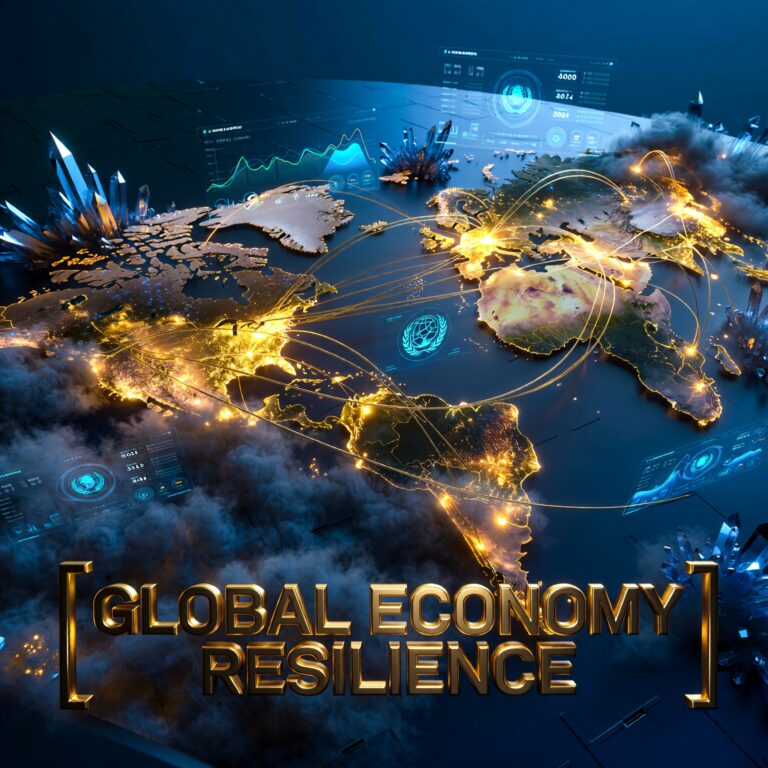
The broader implication of the 15% tariff fallout is the potential fragmentation of the Global Economy. For the last thirty years, globalization has been the dominant force, driving down costs and lifting millions out of poverty in emerging markets. The shift toward protectionism signals the end of the “hyper-globalization” era.
Emerging Markets at Risk
Developing nations that rely heavily on exports to the U.S. market face an existential threat. Countries in Southeast Asia, Latin America, and even parts of Africa have built their economic strategies around access to the American consumer. A 15% barrier could render their exports uncompetitive, leading to currency devaluations and sovereign debt crises.
When emerging market currencies collapse against the dollar, it becomes more expensive for those nations to service their dollar-denominated debt. This can trigger a cascade of defaults, similar to the Asian Financial Crisis of the late 90s, but with potentially wider reach given the current high-interest-rate environment.
Supply Chain Re-shoring vs. Friend-shoring
In response to the tariffs and the legal uncertainty of Section 122, multinational corporations are accelerating their supply chain diversification. This is often termed “friend-shoring”—moving production to allied nations. While this reduces reliance on geopolitical rivals, it is an expensive and slow process. Building new factories and training workforces takes years. In the interim, supply constraints will persist, keeping upward pressure on Inflation.
The Role of Central Banks in a Tariff Era
The intersection of trade policy and monetary policy is where the true danger lies. Central banks, particularly the Federal Reserve, operate on data. If tariffs cause a spike in the Consumer Price Index (CPI), the Fed’s mandate compels them to react.
The Stagflation Trap
The worst-case scenario for the Global Economy is stagflation: stagnant growth combined with high inflation. Tariffs are inherently inflationary (raising prices) and contractionary (reducing trade volume and growth). If the 15% tariff is implemented, we could see GDP growth slow while prices rise.
In a stagflationary environment, the tools of the central bank become blunt. Raising interest rates fights inflation but worsens the economic slowdown. Cutting rates stimulates growth but fuels inflation. This paralysis can lead to a loss of confidence in fiat currencies and a flight to hard assets like gold or commodities, further destabilizing financial markets.
Historical Precedents: Lessons from Smoot-Hawley
To understand the potential severity of the current situation, economists often look to the Smoot-Hawley Tariff Act of 1930. While modern economists debate the extent to which Smoot-Hawley caused the Great Depression, there is consensus that it significantly worsened it.
The Act raised U.S. tariffs on over 20,000 imported goods. The result was immediate retaliation from trading partners. Global trade plummeted by approximately 66% between 1929 and 1934. While the current 15% proposal is not as extreme as the rates in the 1930s, the psychological impact is similar. It signals a retreat from cooperation and an embrace of economic nationalism.
However, the modern Global Economy is different. Supply chains are more complex, and financial markets are more interconnected. A shock in one part of the system travels instantly to others. The speed of transmission means that the fallout from a modern Trade War could be felt much faster than in the 1930s.
Market Volatility and Investment Strategy
For investors, the 15% tariff fallout necessitates a shift in strategy. The era of passive indexing and “buy and hold” may face significant headwinds if volatility becomes the new normal.
Sector Rotation
Investors may need to rotate out of import-heavy sectors and into domestic-focused companies. Utilities, domestic healthcare providers, and companies with strong pricing power may offer safer havens. Conversely, companies with high exposure to international supply chains or heavy reliance on exports should be viewed with caution.
The Dollar Dilemma
Paradoxically, tariffs often strengthen the domestic currency in the short term by reducing imports and demand for foreign currency. A stronger dollar makes U.S. exports even more expensive, exacerbating the trade deficit—the very problem the tariffs were meant to solve. This “strong dollar” dynamic can crush earnings for U.S. multinationals, as their overseas revenue is worth less when converted back to dollars.
The Path Forward: Negotiation or Escalation?
Is the 15% tariff a negotiating tactic or a permanent policy shift? This is the trillion-dollar question.
If it is a bluff designed to force concessions on intellectual property or market access, markets may eventually stabilize once a deal is struck. However, if it is a genuine ideological shift toward autarky (national self-sufficiency), the Global Economy must prepare for a prolonged period of adjustment.
The use of Section 122 suggests a desire for immediate leverage, but sustainable trade relationships are built on treaties and long-term agreements, not emergency decrees. For stability to return, there must be a clear roadmap. Markets need to know the rules of the game. Without clarity, the risk premium on all assets will remain elevated.
Conclusion: Bracing for Impact
The proposal of a 15% tariff is more than a line item in a budget; it is a geopolitical earthquake. By leveraging Section 122 and pushing for Reciprocal Tariffs, policymakers are gambling that the short-term pain of Inflation and market volatility will yield long-term strategic gains.
However, the risks to the Global Economy are profound. From the potential reignition of a Trade War to the disruption of intricate supply chains, the fallout could be severe. Consumers will pay more, businesses will face uncertainty, and central banks will face impossible choices.
As we move forward, vigilance is key. Investors must watch for signs of retaliation, monitor inflation data closely, and remain agile. The era of frictionless global trade may be ending, replaced by a new reality where economic security trumps economic efficiency. In this new world, the 15% tariff is not just a tax; it is the opening salvo of a new economic order.
Frequently Asked Questions
What is Section 122 and how does it relate to tariffs?
Section 122 refers to a provision within the International Emergency Economic Powers Act (IEEPA). It grants the President authority to regulate commerce during a declared national emergency. In the context of tariffs, it is being discussed as a legal mechanism to impose broad import taxes without needing new legislation from Congress, bypassing traditional gridlock.
How will the 15% tariff affect inflation?
Tariffs act as a tax on imports. When the cost of importing goods rises by 15%, businesses typically pass these costs on to consumers. This leads to “cost-push inflation,” where the prices of everyday goods like electronics, clothing, and auto parts increase, potentially reversing progress made by central banks in lowering inflation rates.
What are Reciprocal Tariffs?
Reciprocal Tariffs are a trade policy where a country matches the tariff rates of its trading partners. For example, if Country A charges a 20% tariff on U.S. goods, the U.S. would charge a 20% tariff on goods from Country A. The goal is to create “fair” trade, but it often leads to escalating trade wars.
Which sectors of the Global Economy are most at risk?
The technology, automotive, and retail sectors are most vulnerable due to their reliance on complex global supply chains. Additionally, the agricultural sector is at high risk of retaliatory tariffs from other nations, which can cut off vital export markets for farmers.
Could this lead to a new Trade War?
Yes. History suggests that imposing significant tariffs often leads to retaliation from trading partners. If other nations respond with their own tariffs on U.S. exports, it creates a cycle of escalation known as a Trade War, which can shrink global GDP and disrupt international relations.