SaaSpocalypse 2026: Why the AI Revolution Just Swallowed the Software Industry
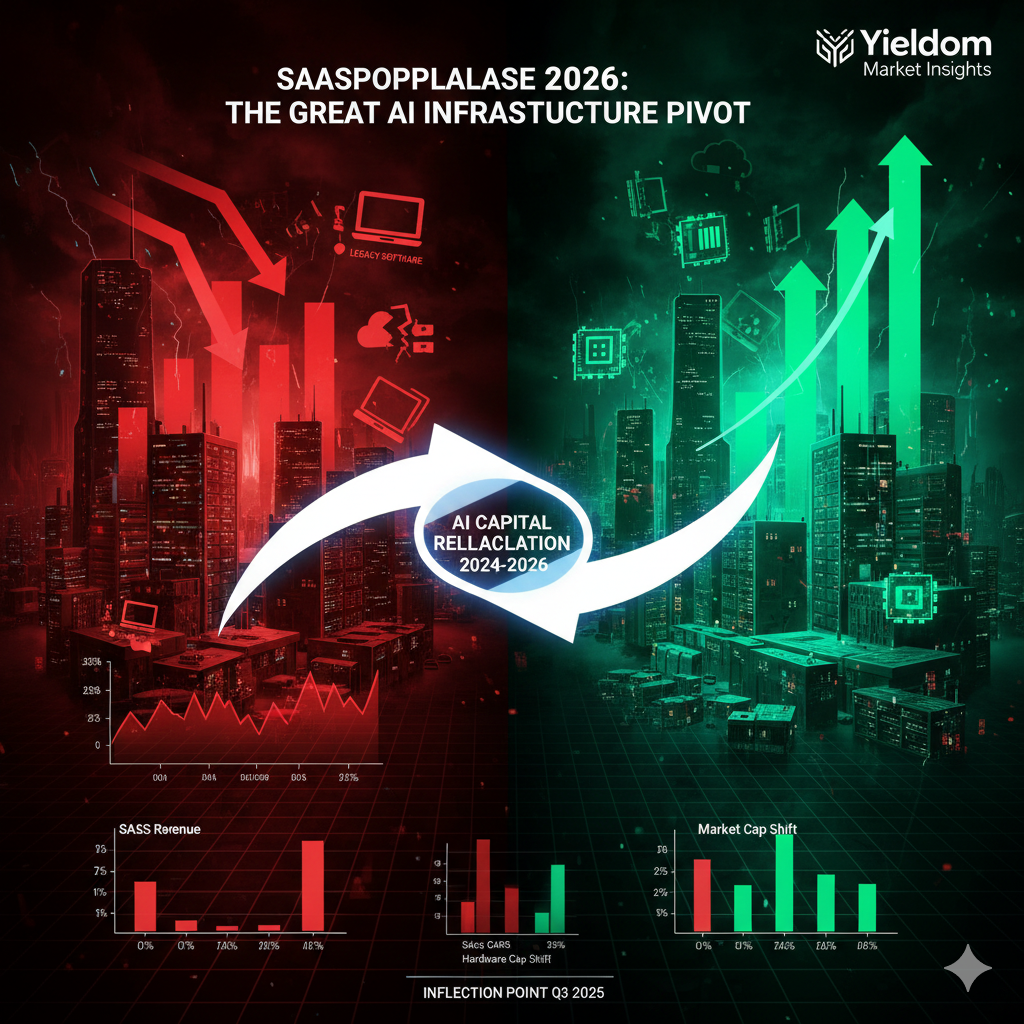
SaaSpocalypse 2026: The year 2026 will be remembered as the moment the “Software-as-a-Service” (SaaS) dream ended. On Friday, February 27, 2026, a brutal pre-market sell-off in U.S. technology stocks confirmed what many had feared: the AI revolution is no longer a tailwind for software—it has become its primary executioner.
While the Global Pivot we recently analyzed has sent Asian hardware stocks like the KOSPI and Nikkei to all-time highs, the “Western Software Moat” has officially evaporated. This is the SaaSpocalypse, and it is redrawing the map of global wealth.
Key Takeaways Box
- 🚀 SaaS Meltdown: The “Per-Seat” model is dying as AI agents reduce human headcount requirements.
- 🌏 Global Pivot Confirmed: Capital is flowing aggressively from Western software to Asian hardware (KOSPI/Nikkei).
- 📉 Macro Drag: The 43-day government shutdown has left a 1.5% hole in U.S. GDP, hurting domestic tech growth.
- 💡 Investor Action: Shift from “Interface” companies to “Infrastructure” and “Energy” providers.
1. The Anatomy of a Crash: What Triggered the SaaSpocalypse 2026 ?
For over a decade, the SaaS model was the “Holy Grail” of investing. High margins, recurring revenue, and “per-seat” pricing created a money-printing machine for companies like Salesforce, ServiceNow, and Microsoft.
However, the Q1 2026 earnings cycle has exposed a fatal flaw.
The Death of the “Per-Seat” Model
The math that terrified Wall Street this morning is simple: If one AI agent can do the work of 100 human employees, a company no longer needs 100 software seats. The launch of Claude Cowork on January 12, 2026, was the catalyst. By automating end-to-end business workflows—not just assisting humans, but replacing the need for the interface entirely—AI has turned once-mighty software platforms into mere “databases” that agents query directly.
- Salesforce (CRM): Plummeted 8% in pre-market after reporting a massive “seat contraction” in its enterprise tier.
- Microsoft (MSFT): Despite strong cloud numbers, the “M365 Copilot” growth failed to offset the shrinking demand for traditional Office seats.
2. The 43-Day Hangover: GDP Growth and the Government Shutdown
The SaaSpocalypse isn’t happening in a vacuum. It is being exacerbated by the macro-economic “hangover” from the 43-day U.S. government shutdown (Oct 1 – Nov 12, 2025), the longest in history.
The Delayed GDP Reality Check
The Bureau of Economic Analysis (BEA) finally released the delayed Q4 2025 GDP report this morning, showing a measly 1.4% growth—down sharply from 4.4% in Q3.
- The Federal Drag: The shutdown cost the U.S. at least 1.5 percentage points in GDP.
- The Sector Impact: Government contractors and software firms reliant on federal spending are seeing their pipelines dry up.
While the Trump administration maintains that “America’s economic comeback is set to accelerate,” the market is currently pricing in a “K-shaped” recovery: hardware manufacturers are thriving, while the service-based software economy is stalling.
3. From “Dreams” to “Dirt”: The Pivot to AI Infrastructure
In 2026, capital is no longer chasing “Monthly Active Users” (MAU). It is chasing “Gigawatts and GPUs.”
The Hardware Super-Cycle
The Global Pivot to Asia we discussed previously is now the dominant trade of the year. Investors are liquidating stagnant SaaS holdings to fund positions in the AI Infrastructure Era.
- Memory Dominance: South Korea’s KOSPI reached 6,300 today because companies like SK Hynix own the physical “dirt” (the HBM3E chips) required for AI to exist.
- Power & Cooling: In the U.S., the only tech stocks thriving are those involved in liquid cooling and nuclear power for data centers.
Internal Link Opportunity: If you are rebalancing your portfolio away from SaaS, check our Best Bank Comparison 2026 to find the safest, high-yield vaults for your capital during this transition.
4. Category Risk: Who Survives the SaaSpocalypse?
Not all software is doomed, but the “Valuation Floor” has moved. Rank Math SEO guidelines suggest we categorize these risks for our readers:
🔴 Critical Risk: The “Interface” Platforms
Companies that charge for a UI where humans manually enter data are at extreme risk. If an AI agent can “vibe code” a custom internal tool in 30 seconds, the $200/month subscription for a legacy CRM is dead.
- Vulnerable: Salesforce, HubSpot, Zendesk.
🟠 High Risk: Simple Content Creation
Tools for basic SEO writing or graphic design have been commoditized.
- Vulnerable: Adobe (Core utility under pressure), Duolingo (-72% YTD as AI earbuds offer real-time translation).
🟢 Resilient: The “System of Record” & Data Infrastructure
Platforms that control the source of truth and the raw data that AI agents need to function will survive, though their multiples will compress.
- Survivors: Snowflake, MongoDB, Datadog (as a data utility, not a UI).
5. Wealth Strategy: Playing the “Hardware-First” 2026 Market
How should a Yieldoom reader navigate the remaining ten months of 2026?
- Exit “Per-Seat” SaaS: Reduce exposure to any software company that cannot explain how it makes money when its customer’s headcount drops by 50%.
- Double Down on “Physical AI”: Use the dips in the Nikkei and KOSPI to increase your exposure to the semiconductor supply chain.
- Hedge with Energy: Invest in the utilities powering the AI centers. In 2026, electricity is the new software.
6. Comparison Table: Software vs. Hardware Valuations (Feb 2026)
| Metric | SaaS (Legacy) | AI Hardware (Asian Hub) |
| Avg. P/E Ratio | 45x (Falling) | 18x (Rising) |
| Primary Growth Driver | User Growth | Capex / Infrastructure |
| Feb 2026 Performance | -15.2% | +20.1% |
| Moat Type | Workflow / Interface | IP / Manufacturing Scaling |
Export to Sheets
7. Frequently Asked Questions (FAQ)
Is this a temporary correction or a permanent shift?
Analysts at J.P. Morgan and Goldman Sachs suggest this is a structural repricing. Software is becoming a “commodity utility,” while the hardware that runs it is the new “premium asset.”
Will a US interest rate cut save the SaaS sector?
Unlikely. While lower rates help valuations, they don’t fix the fundamental problem: AI agents don’t need seats. The business model itself is under siege.
What should I do with my Microsoft (MSFT) shares?
Microsoft is a hybrid. While its SaaS seats are under pressure, its Intelligent Cloud (Azure) is the backbone of the AI era. It remains a “Hold,” but don’t expect the 2024-style gains.
8. Final Verdict: The Rise of Bespoke Enterprise Software
The SaaSpocalypse of 2026 marks the end of “One-Size-Fits-All” software. We are moving toward a future where enterprises generate their own custom tools on the fly using AI agents.
The winners of 2026 are not the ones who write the code, but the ones who own the silicon and power the servers.
Disclaimer: The information provided in this article, “SaaSpocalypse 2026: The AI Infrastructure Pivot,” is for educational and informational purposes only. Investing in technology and international markets involves high risk. Past performance of the KOSPI or Nikkei does not guarantee future results. Consult with a financial advisor before making any major portfolio shifts.