Global Economy Faces New Strain From Iran Conflict: Markets, Oil & Trade at Risk
Escalating geopolitical tensions in the Middle East have introduced a fresh layer of uncertainty for international markets. As the Iran conflict global economy nexus tightens, policymakers, investors, and businesses are bracing for potential ripple effects across energy, trade, and financial stability.
This article examines how renewed friction involving Iran could strain the global economy, from oil price volatility and supply chain disruptions to inflationary pressures and emerging market vulnerability. Understanding these dynamics is critical for navigating an increasingly fragile macroeconomic landscape.
Table of Contents
- Why the Iran Conflict Matters for the Global Economy
- Oil Markets: The First Transmission Channel
- Trade & Supply Chain Disruptions
- Inflation & Central Bank Policy Dilemmas
- Emerging Markets & Currency Volatility
- Financial Markets: Risk-Off Rotation
- Historical Precedents: Lessons from Past Iran Tensions
- Scenario Analysis: Base, Escalation, and Containment Cases
- Frequently Asked Questions
Why the Iran Conflict Matters for the Global Economy:
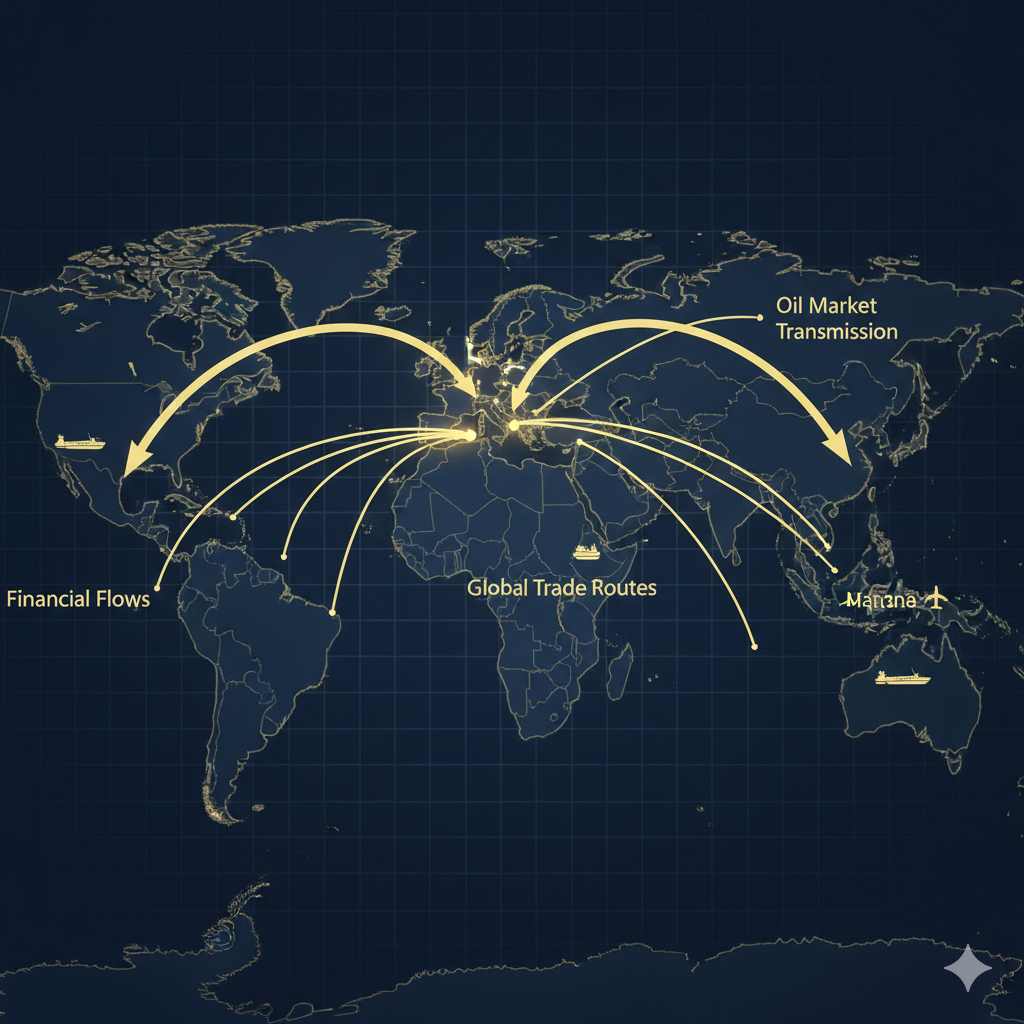
The Iran conflict global economy link operates through multiple interconnected channels:
| Channel | Mechanism | Potential Impact |
|---|---|---|
| Energy | Iran sits atop the Strait of Hormuz; 21% of global oil transits here | Supply shock → price spike → inflation |
| Trade | Regional instability disrupts shipping lanes & insurance markets | Higher freight costs, delivery delays |
| Finance | Risk aversion triggers capital flight from EM assets | Currency depreciation, debt stress |
| Commodities | Geopolitical premium lifts oil, gold, agricultural prices | Input cost inflation for businesses |
Unlike isolated regional conflicts, tensions involving Iran have outsized global implications due to: ✅ Its strategic location controlling critical maritime chokepoints
✅ Its role as a major oil producer and OPEC+ participant
✅ Its network of regional proxies that can amplify conflict scope
When analysts warn that the global economy faces new strain from Iran conflict, they are referencing this complex web of transmission risks.
Oil Markets: The First Transmission Channel:
Energy markets react first—and fastest—to Middle East escalation. The Iran conflict global economydynamic is most visible in crude oil pricing.
Supply Disruption Scenarios
| Scenario | Probability | Estimated Price Impact |
|---|---|---|
| Verbal threats only | High | +$3-5/bbl (risk premium) |
| Tanker harassment/mining | Medium | +$10-20/bbl |
| Strait of Hormuz closure | Low (but high impact) | +$30-50/bbl short-term |
| Direct production infrastructure attack | Low-Medium | +$15-25/bbl + volatility spike |
Market Structure Amplifiers
- Low spare capacity: OPEC+ spare production is near multi-year lows (~2.5M bpd), limiting supply response
- Strategic Petroleum Reserve (SPR) limits: U.S. and IEA reserves are depleted post-2022 releases
- Financial positioning: Net-long speculative positions in crude can accelerate price moves on headlines
Key Levels to Watch:
1234Brent Crude:• Support: $82/bbl → $78/bbl• Resistance: $92/bbl → $98/bbl (conflict premium zone)• Break above $100 = recession risk threshold for many economies
Trade & Supply Chain Disruptions:
Beyond oil, the Iran conflict global economy strain manifests in trade flows and logistics.
Shipping & Insurance Impacts
- War risk premiums: Insurance costs for vessels transiting the Persian Gulf can jump 5-10x during escalation
- Rerouting delays: Ships avoiding the region add 7-14 days to Asia-Europe routes via Cape of Good Hope
- Port congestion: Alternative hubs (e.g., Fujairah, Salalah) face capacity constraints
Commodity Supply Chains
| Commodity | Iran/Regional Role | Disruption Risk |
|---|---|---|
| Petrochemicals | Iran is top-10 global producer | Export halts → polymer price spikes |
| Metals | Regional aluminum, copper production | Energy cutoffs → smelter shutdowns |
| Agriculture | Black Sea/Middle East grain corridors | Conflict spillover → food inflation |
Business Impact: Just-in-time manufacturing models face renewed stress. Companies with exposure to Middle East logistics should audit supply chain resilience now.
Inflation & Central Bank Policy Dilemmas:
The Iran conflict global economy feedback loop complicates monetary policy just as central banks seek to anchor inflation expectations.
Inflation Transmission Pathways
1234Oil price shock → ↑ Transport & energy costs → ↑ Producer Price Index (PPI) → ↑ Consumer Price Index (CPI) with 3-6 month lag
Central Bank Response Matrix
| Central Bank | Current Stance | Conflict-Induced Dilemma |
|---|---|---|
| Federal Reserve | Data-dependent, higher-for-longer | Inflation re-acceleration vs. growth slowdown |
| ECB | Cautiously hawkish | Stagflation risk in energy-importing Eurozone |
| BoJ | Ultra-loose policy | Yen weakness + import inflation pressure |
| Emerging Markets | Mixed (some hiking, some cutting) | Capital outflows + currency depreciation + imported inflation |
Key Insight: A sustained oil spike above $95/bbl could add 0.3-0.8 percentage points to global CPI in 2024—potentially delaying rate cuts and extending restrictive policy.
Emerging Markets & Currency Volatility:
The Iran conflict global economy strain disproportionately impacts emerging markets (EMs) through three channels:
1. Capital Flight
Risk-off sentiment triggers outflows from EM equities and bonds. The IMF estimates that a 10-point VIX spike correlates with ~$15B in weekly EM portfolio outflows.
2. Currency Depreciation
| Currency | Vulnerability Driver |
|---|---|
| Turkish Lira | High energy import dependence + political risk |
| Egyptian Pound | Suez Canal revenue exposure + external debt |
| Pakistani Rupee | Oil import bill + IMF program sensitivity |
| South African Rand | Commodity exporter but risk-sensitive flows |
3. Debt Sustainability Stress
Rising global rates + stronger USD + higher oil import bills = deteriorating debt metrics for frontier markets. The World Bank estimates 60% of low-income countries are at high risk of debt distress.
Investor Takeaway: EM asset selection matters more than ever. Favor commodity exporters with strong external balances; avoid high external debt, energy-importing nations.
Financial Markets: Risk-Off Rotation:
When the global economy faces new strain from Iran conflict, asset correlations shift dramatically.
Typical Risk-Off Rotation Pattern
1234567891011OUT: • Equities (especially cyclicals, EM stocks)• High-yield bonds• Commodities (except gold, oil)• EM currenciesINTO:• Gold, Swiss Franc, Japanese Yen• U.S. Treasuries (especially 2-5yr)• Investment-grade credit• Cash (USD, CHF)
Volatility Regime Change
- VIX: Can spike 8-12 points on escalation headlines
- MOVE Index (bond volatility): Rises as rate uncertainty increases
- Cross-asset correlations: Equity-bond correlation often turns positive during geopolitical shocks (both fall)
Portfolio Implication: Traditional 60/40 portfolios may underperform if equities and bonds sell off together. Explicit safe-haven allocations (gold, trend-following strategies) add resilience.
Historical Precedents: Lessons from Past Iran Tensions:
Examining prior episodes helps calibrate the Iran conflict global economy risk:
2019-2020: U.S.-Iran Escalation (Soleimani Strike)
- Oil: Brent +8% in one week, then retraced as de-escalation occurred
- Equities: S&P 500 -3% peak-to-trough; recovered within 2 weeks
- Key Lesson: Short-lived spikes unless conflict broadens regionally
2011-2012: Strait of Hormuz Threats
- Oil: Sustained $10-15/bbl risk premium for ~6 months
- Global Growth: IMF downgraded 2012 forecast by 0.3pp due to oil drag
- Key Lesson: Prolonged uncertainty creates tangible macro drag
1979-1980: Iranian Revolution & Hostage Crisis
- Oil: Prices doubled from $14 to $28/bbl in 12 months
- Global Impact: Contributed to early-1980s recession in OECD economies
- Key Lesson: Structural supply disruption has long-lasting effects
Current Context: Today’s Iran conflict global economy dynamic unfolds amid higher debt levels, tighter monetary policy, and fragmented geopolitics—amplifying potential second-round effects.
Scenario Analysis: Base, Escalation, and Containment Cases:
Base Case (60% Probability): Contained Tensions
- Assumptions: Rhetoric escalates but no direct military confrontation; Strait of Hormuz remains open
- Oil: $85-92/bbl range (modest risk premium)
- Global Growth: Minimal impact; 0.1-0.2pp drag on 2024 GDP
- Markets: Elevated volatility but no structural breakdown
Escalation Case (30% Probability): Limited Military Exchange
- Assumptions: Targeted strikes on infrastructure; temporary shipping disruptions
- Oil: $95-110/bbl spike for 4-8 weeks
- Global Growth: 0.3-0.6pp downgrade to 2024 forecasts; stagflation concerns rise
- Markets: Risk-off rotation; EM stress; safe havens outperform
Containment Failure Case (10% Probability): Regional War
- Assumptions: Broad conflict involving multiple state/non-state actors; Strait closure
- Oil: $120-150/bbl potential; global recession likely
- Global Growth: 1.0-2.0pp negative revision; policy crisis for central banks
- Markets: Liquidity stress; correlation breakdown; flight to quality extreme
Strategic Implication: Portfolio positioning should reflect this probability-weighted framework—not just the base case.
Frequently Asked Questions:
How does the Iran conflict affect the global economy?
The Iran conflict global economy link operates through oil prices, trade routes, financial flows, and commodity markets. Disruptions can trigger inflation, slow growth, and increase market volatility worldwide.
What happens to oil prices if tensions escalate?
Brent crude could rise $10-20/bbl on limited escalation, or $30-50/bbl if the Strait of Hormuz is threatened. Sustained prices above $95/bbl increase global recession risk.
Which countries are most vulnerable to this strain?
Energy-importing emerging markets (Turkey, Egypt, Pakistan), highly indebted nations, and economies with large current account deficits face the greatest vulnerability.
How should investors position portfolios?
Consider: (1) increasing safe-haven exposure (gold, Treasuries), (2) reducing EM debt/currency risk, (3) adding volatility hedges, and (4) maintaining liquidity for opportunities.
Could this delay central bank rate cuts?
Yes. A sustained oil-driven inflation spike could force central banks to maintain restrictive policy longer, particularly the Fed and ECB.
Conclusion
The warning that the global economy faces new strain from Iran conflict is not alarmism—it is a recognition of interconnected risks in an already fragile macro environment. Energy markets, trade flows, inflation dynamics, and financial stability all transmit shockwaves from Middle East tensions to balance sheets worldwide.
For policymakers, the challenge is balancing deterrence with de-escalation. For investors, the imperative is resilience: diversifying across uncorrelated safe havens, stress-testing portfolios for oil spikes, and maintaining flexibility. For businesses, the priority is supply chain agility and scenario planning.
In an era of polycrisis, the Iran conflict global economy nexus reminds us that geography still matters—and that preparedness separates the resilient from the reactive.