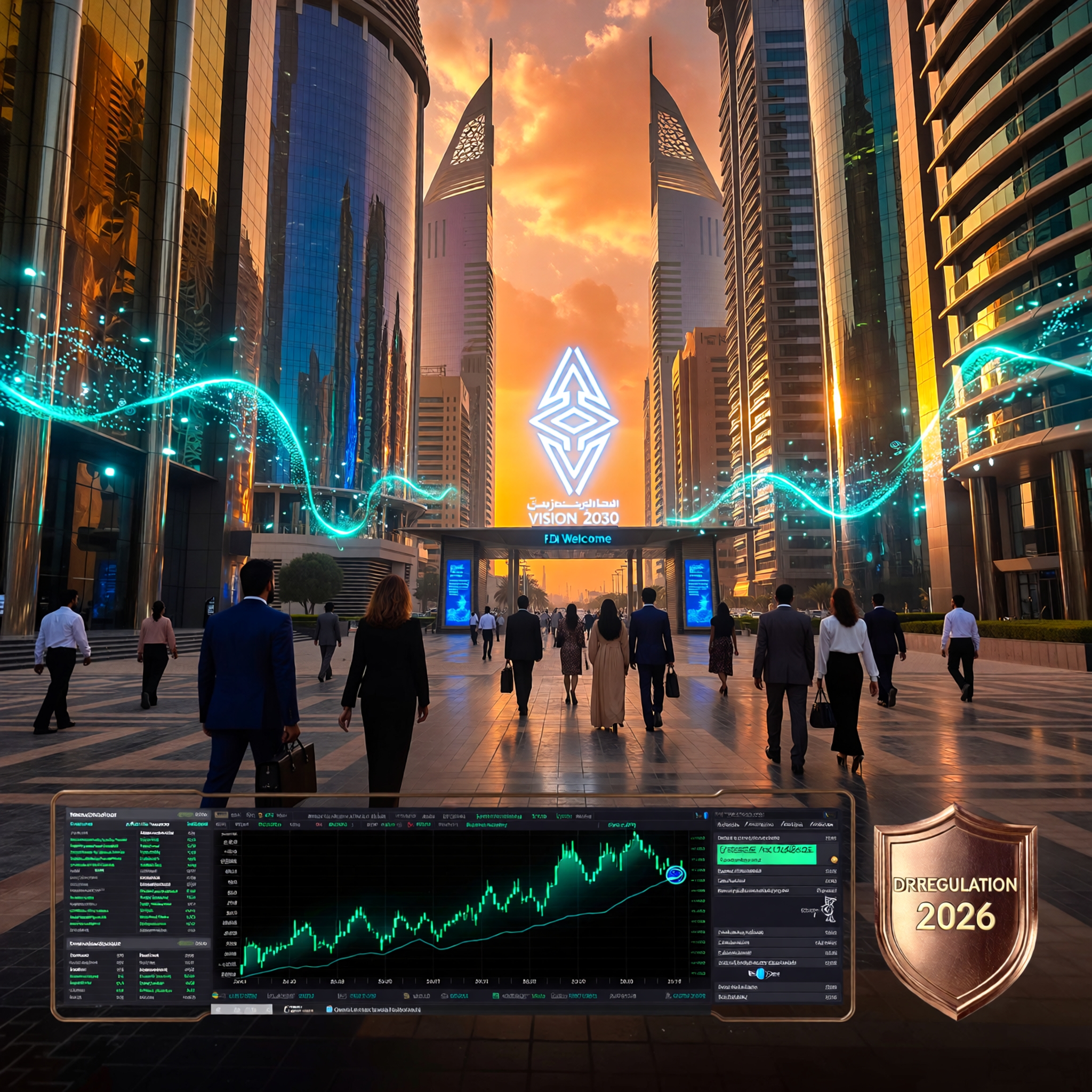
Saudi Arabia Deregulates Financial Markets to Boost FDI & Vision 2030
In a landmark move that signals the most aggressive financial opening in the Middle East’s history, Saudi Arabia has officially launched a sweeping deregulation of its financial markets, inviting global investors to participate in one of the world’s fastest-growing economies.
This isn’t just another policy tweak. It’s a strategic detonation of capital controls, ownership limits, and bureaucratic barriers—designed to transform the Kingdom from an oil-dependent state into a global investment hub by 2030.
For international investors, asset managers, and multinational corporations, this represents a generational opportunity. For Saudi Arabia, it’s the financial engine of Vision 2030—and the key to unlocking $100+ billion in annual Foreign Direct Investment (FDI) by the end of the decade.
In this deep-dive analysis, we explore:
- The specific deregulation measures now in effect
- How this accelerates Vision 2030’s economic diversification
- The explosive capital markets momentum already underway
- What FDI opportunities are emerging (and which sectors to watch)
- Risks, challenges, and how to position your portfolio
🌍 Why Now? The Strategic Imperative Behind Deregulation
For decades, Saudi Arabia’s economy ran on oil. In 2014, oil accounted for 90% of government revenueand 45% of GDP. But with global energy transitions accelerating and oil price volatility increasing, Crown Prince Mohammed bin Salman (MBS) launched Vision 2030 in 2016—a bold plan to diversify the economy, create jobs, and reduce oil dependence.
Yet Vision 2030 faced a fundamental challenge: capital scarcity. The Kingdom needed trillions in investmentto build NEOM, Red Sea tourism, giga-projects, and tech infrastructure. Domestic savings and oil revenues weren’t enough.
The solution? Open the doors.
“We are not just selling assets. We are selling a future.”
— Crown Prince Mohammed bin Salman, 2025
The 2026 Financial Market Deregulation Package is the culmination of a decade of groundwork—removing the final barriers that kept global capital at bay.
📜 Key Deregulation Measures: What’s Changed?
Announced in January 2026 by the Capital Market Authority (CMA) and Saudi Central Bank (SAMA), the new framework includes:
✅ 1. 100% Foreign Ownership in Listed Companies
- Previously: Foreigners capped at 49% in most sectors
- Now: Unlimited ownership in all Tadawul-listed equities, including banking, insurance, and telecom
- Impact: Unlocks $1.2 trillion in market cap to global portfolio investors
✅ 2. Streamlined FDI Licensing (30-Day Approval)
- Previously: 6–12 months for investment permits
- Now: Single-window FDI portal with 30-day approval guarantee
- Special zones: NEOM, Qiddiya, and King Abdullah Financial District (KAFD) offer tax holidays and 100% repatriation
✅ 3. Derivatives & Short-Selling Permitted
- New: Launch of Saudi Futures Exchange (SAFEX)
- Instruments: Index futures, single-stock options, currency forwards
- Significance: Enables hedging, institutional risk management, and algorithmic trading
✅ 4. Bond Market Liberalization
- Sukuk & conventional bonds now open to foreign buyers without quotas
- Yield advantage: 10-year Saudi riyal bonds yield 5.2%—vs. 4.1% for U.S. Treasuries
- Currency stability: Riyal pegged to USD reduces FX risk
✅ 5. Digital Asset & Fintech Sandbox
- Crypto firms can now operate under CMA’s regulatory sandbox
- Goals: Position Riyadh as a global fintech hub by 2030
💡 Bottom Line: Saudi Arabia is no longer just accessible—it’s investor-friendly.
🚀 Vision 2030: How Deregulation Supercharges the Economic Transformation
Vision 2030 isn’t just a slogan—it’s a $1.3 trillion economic blueprint. And financial deregulation is its oxygen supply.
1. Diversification Beyond Oil
- 2025: Oil still 30% of GDP
- 2030 Target: <15%
- New engines: Tourism, mining, logistics, entertainment, renewables
2. NEOM & Giga-Projects
- NEOM: $500B smart city (170 km of linear infrastructure)
- The Red Sea Project: 50 resorts, 22 islands
- Qiddiya: “Saudi’s entertainment capital”
- Funding: 60% from private investment (domestic + foreign)
3. Job Creation for Saudis
- Target: 1.2 million new private-sector jobs by 2030
- FDI requirement: Minimum 30% Saudi employment in licensed projects
📊 Progress: Non-oil exports grew 22% YoY in 2025—the fastest in G20.
📈 Capital Markets Momentum: The Data Speaks
Saudi Arabia’s capital markets are already surging—before full deregulation.
Tadawul (Saudi Stock Exchange)
- Market Cap: $1.2 trillion (largest in MENA)
- 2025 Performance: +18% (vs. MSCI World: +9%)
- Liquidity: Avg. daily volume up 35% YoY
Bond Market Growth
- Outstanding Sukuk: $350 billion
- Foreign ownership: Rose from 2% (2020) to 12% (2025)
ETF Inflows
- iShares MSCI Saudi Arabia ETF (KSA): $1.8B AUM (+40% in 2025)
- New launches: BlackRock, Vanguard planning Saudi-focused ETFs in 2026
IPO Pipeline
- 2026–2027: 30+ state-owned companies to list, including:
- Saudi Aramco downstream (refining, petrochemicals)
- National Renewable Energy Co.
- Saudi Telecom (stc) digital division
🔥 Analyst Take: “Saudi is the only emerging market with strong fundamentals, high yields, and political will to open.” — JPMorgan, Jan 2026
💰 Foreign Direct Investment (FDI): Where the Money Is Going
Saudi Arabia’s FDI inflows hit $21 billion in 2025—a record. But the 2026 deregulation is expected to double that by 2027.
Top Sectors for FDI (2026–2030)
| Sector | Key Opportunities | Incentives |
|---|---|---|
| Renewables | Solar, wind, green hydrogen | 30-year tax breaks, land grants |
| Mining | Copper, phosphate, gold | 100% foreign ownership, royalty discounts |
| Fintech | Digital banking, InsurTech, crypto | Regulatory sandbox, 0% corporate tax for 10 years |
| Healthcare | Hospitals, biotech, medtech | Fast-track licensing, 50% cost subsidy |
| Tourism | Hotels, attractions, luxury travel | 100% repatriation, visa-free entry for 60+ countries |
Major Announcements (2025–2026)
- Apple: $1B AI R&D center in Riyadh
- BlackRock: $5B infrastructure fund
- Siemens: $3B green hydrogen plant
- Lucid Motors: EV factory (50% Saudi-owned)
🌐 FDI Target: $100 billion/year by 2030 (up from $21B in 2025)
⚖️ Risks & Challenges: What Investors Should Watch
Despite the momentum, Saudi Arabia isn’t without risks.
1. Geopolitical Tensions
- Regional instability (Yemen, Iran) could spook short-term capital
- Mitigation: Saudi’s $700B sovereign wealth fund (PIF) acts as a market stabilizer
2. Governance & Transparency
- Still an absolute monarchy—policy shifts can be abrupt
- Progress: CMA now aligns with IOSCO standards; corporate governance improving
3. Liquidity in Small Caps
- Large caps (Aramco, Al Rajhi) are liquid—but mid/small caps aren’t
- Solution: Focus on blue chips or ETFs for early exposure
4. Cultural & Operational Hurdles
- Business culture differs from West (relationship-driven, hierarchical)
- Tip: Partner with local sponsors or use Saudi investment councils
💡 Verdict: Risks are outweighed by opportunity—especially for long-term investors.
📊 How to Invest: Practical Strategies for Global Investors
Option 1: Passive Exposure (Low Risk)
- ETFs: iShares MSCI Saudi Arabia (KSA), Franklin FTSE Saudi Arabia (FLSA)
- Global EM Funds: Most now overweight Saudi (avg. 8–12% allocation)
Option 2: Active Equity (Medium Risk)
- Focus sectors: Banking (Al Rajhi), Telecom (stc), Petrochemicals (SABIC)
- Tools: Use Saudi-focused brokers (Albilad, SNB Capital)
Option 3: Direct FDI (High Commitment)
- Steps:
- Register on Saudi Investment Platform (SIP)
- Apply for license (30-day guarantee)
- Open corporate bank account (SAMA-approved)
- Support: Saudi Ministry of Investment (MISA) offers free advisory
Option 4: Fixed Income
- Sukuk: Available via Saudi Government Debt Portal
- Yield: 4.5–5.5% for 5–10 year tenors
- Safety: Backed by oil revenues + PIF
🔮 The Bottom Line: A New Era for Global Capital
Saudi Arabia’s financial deregulation isn’t just about markets—it’s about redefining the Kingdom’s place in the world.
By embracing openness, transparency, and competition, Saudi Arabia is positioning itself as the investment gateway to the Middle East, Africa, and Asia.
For global investors, the message is clear:
The time to build a Saudi allocation is now—not after it’s fully priced in.
With Vision 2030 as the roadmap, capital markets momentum as the engine, and FDI-friendly deregulationas the fuel, Saudi Arabia is offering one of the most compelling risk-adjusted opportunities of the decade.
🔚 Disclaimer
This article is for informational purposes only and does not constitute financial, legal, or investment advice. Investing in emerging markets involves significant risk, including currency, political, and liquidity risk. Conduct thorough due diligence and consult a qualified advisor before making investment decisions.
Frequently Asked Questions
Why did gold prices surge in December 2025?
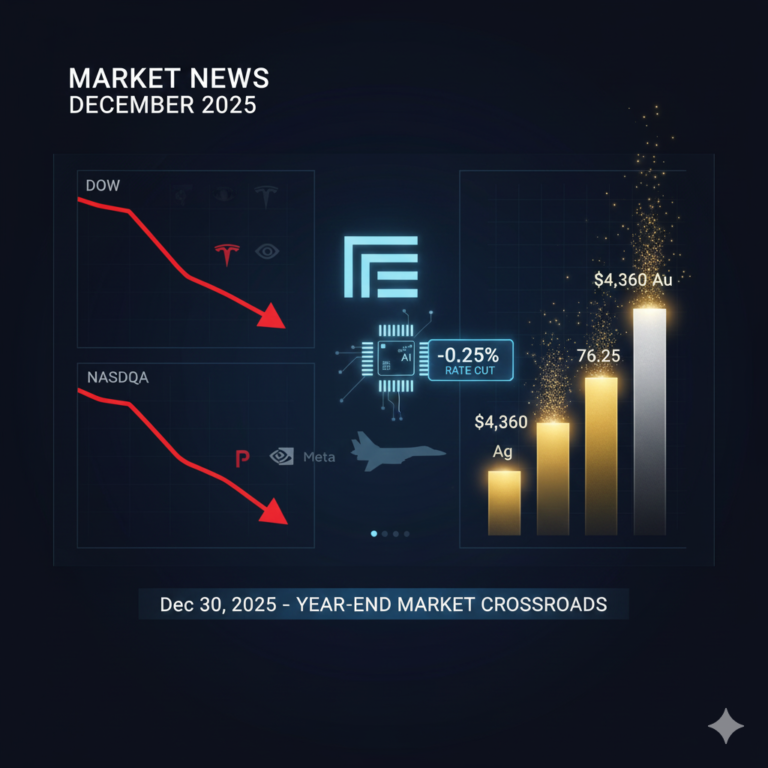
Gold rose over 65% in 2025, hitting $4,560/oz, due to recession fears, Fed rate cuts, geopolitical tensions, and strong demand from central banks. By December 30, it settled at $4,360/oz after a margin-induced selloff.
Did the Fed cut interest rates in December 2025?
Yes. The Fed implemented its third consecutive rate cut in December 2025. Meeting minutes revealed officials are increasingly focused on labor market risks over inflation, signaling potential further cuts in 2026 if unemployment rises.
How is AI affecting the job market at the end of 2025?
AI is displacing entry-level roles in coding, research, and customer service. In response, graduate students are shifting toward “recession-resilient” fields like counseling, law, and mental health—reflecting a “low-hire, low-fire” labor market.
What does the December 2025 market data mean for 2026 investors?
Investors should prepare for lower yields, potential recession, and continued AI disruption. Strategies include locking in high-yield CDs, adding gold as a hedge, auditing AI tool spending, and building a 6–9 month emergency fund. Agility will beat prediction in 2026.