Understanding Yield vs. Interest Rate: Key Differences Explained
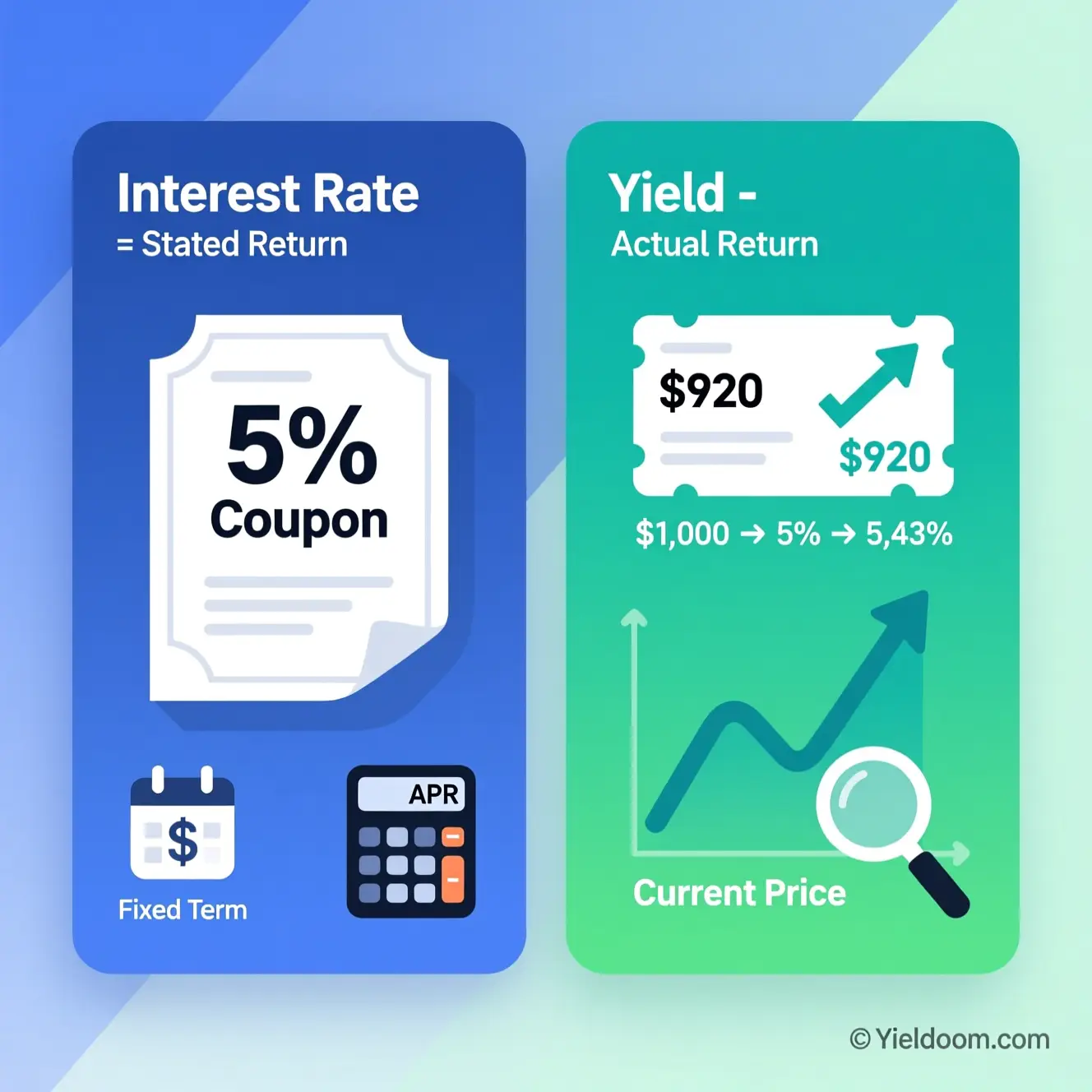
When evaluating fixed-income investments or loan products, two terms often cause confusion: yield vs. interest rate. While related, they are not the same—and misunderstanding them can lead to poor financial decisions. Simply put, it is the stated cost of borrowing or return on lending, typically set at issuance. In contrast, it reflects the actual return an investor earns, accounting for price changes, time, and compounding. Clarifying vs. it is essential for investors, borrowers, and savers alike—especially in today’s shifting rate environment.
🔍 What Is the Interest Rate?
It is the percentage charged by a lender (or paid by a borrower) for the use of money over a specific period. It’s usually expressed as an annual percentage rate (APR) and appears in loan agreements, savings account terms, and bond indentures.
Common Types of Interest Rates:
Coupon rate: Fixed % paid on a bond’s face value (e.g., a $1,000 bond with 5% coupon pays $50/year).
Stated rate: Used in mortgages, car loans, and credit cards.
Federal funds rate: The benchmark rate set by the Federal Reserve for overnight bank lending.
💡 Key trait: Interest rates are contractual—they don’t change after issuance (for fixed-rate instruments).
Example: A 1-year CD with a 4.5% interest rate will pay exactly 4.5% if held to maturity—regardless of market fluctuations.
📈 What Is Yield?
It measures the income return on an investment, expressed as a percentage of its current market price—not face value. Unlike the interest rate, it is dynamic: it changes when the asset’s price moves.
Major Yield Types:
Current yield = Annual interest / Current market price
(e.g., a $900 bond paying $50/year has a 5.56% current yield)
(YTM): Total return if held to maturity, including price appreciation/depreciation and reinvested coupons.
(YTC): For callable bonds—assumes redemption at earliest call date.
💡 Key trait: it reflects realized or expected return—making it more useful for comparing investments.
Example: If a bond’s price falls from $1,000 to $850 (due to rising rates), its yield rises—even though the coupon (interest rate) stays fixed at 5%.
↔️ Key Differences: Yield vs. Interest Rate
Understanding yield vs. interest rate comes down to three core distinctions:
| Factor | **Interest Rate** | **Yield** |
| **Basis** | Face (par) value | Current market price |
| **Stability** | Fixed at issuance (for fixed-rate instruments) | Fluctuates with price |
| **Use Case** | Loan terms, savings accounts, bond coupons | Investment analysis, portfolio comparison |
Real-World Scenario:
You buy a 10-year Treasury note with a 3% interest rate (coupon).
One year later, market rates rise → the note’s price drops to $920.
Its current yeld is now: $30 / $920 = 3.26%
Its YTM (factoring in $80 price gain at maturity) ≈ 4.1%
👉 Even though the interest rate never changed, it did—making it a truer measure of opportunity cost.
💡 Why the Difference Matters to You:
Confusing yield vs. interest rate can lead to costly mistakes:
🚫 Overpaying for bonds: A high coupon (interest rate) may mask a low yield if the bond trades at a premium.
🚫 Underestimating loan costs: APR includes fees—while “interest rate” may not.
✅ Better comparisons: Used to compare a 5% corporate bond at $1,050 (yield: 4.76%) vs. a 4.5% Treasury at $950 (yield: 4.74%).
Financial professionals always prioritize it for investment decisions—but interest rate remains key for budgeting and debt management.
📚 Practical Tips for Investors
For bonds: Always check YTM, not just coupon rate—especially when buying at a discount/premium.
For savings: Compare APY (Annual Percentage)—which accounts for compounding—to simple interest rate.
For loans: Use APR (includes fees) for apples-to-apples comparisons—not the advertised interest rate.
⚠️ Warning: “Zero-coupon” bonds have no interest payments—but still generate it via deep discount pricing (e.g., $700 today → $1,000 in 10 years = ~3.6% YTM).
🔚 Final Takeaway
While the interest rate tells you what’s written on the contract, it tells you what you’re actually earning—or paying—in today’s market. Mastering the distinction between yield vs. interest rate empowers you to make smarter decisions across savings, lending, and investing. Whether you’re evaluating a high-yield savings account, a corporate bond, or a mortgage refinance, always ask: “Is this the rate—or the yield?”
🔗 Further Reading (Internal Linking Suggestions)
Yield Curve Explained: Normal, Inverted, and Flat Types
APR vs. APY: Which Really Matters for Your Savings?
How Rising Rates Affect Bond Prices (The Inverse Relationship).